LR3 drops overnight: how to narrow down the problem
A low corner is useful evidence. Several low corners need more interpretation because the suspension can re-level while parked.
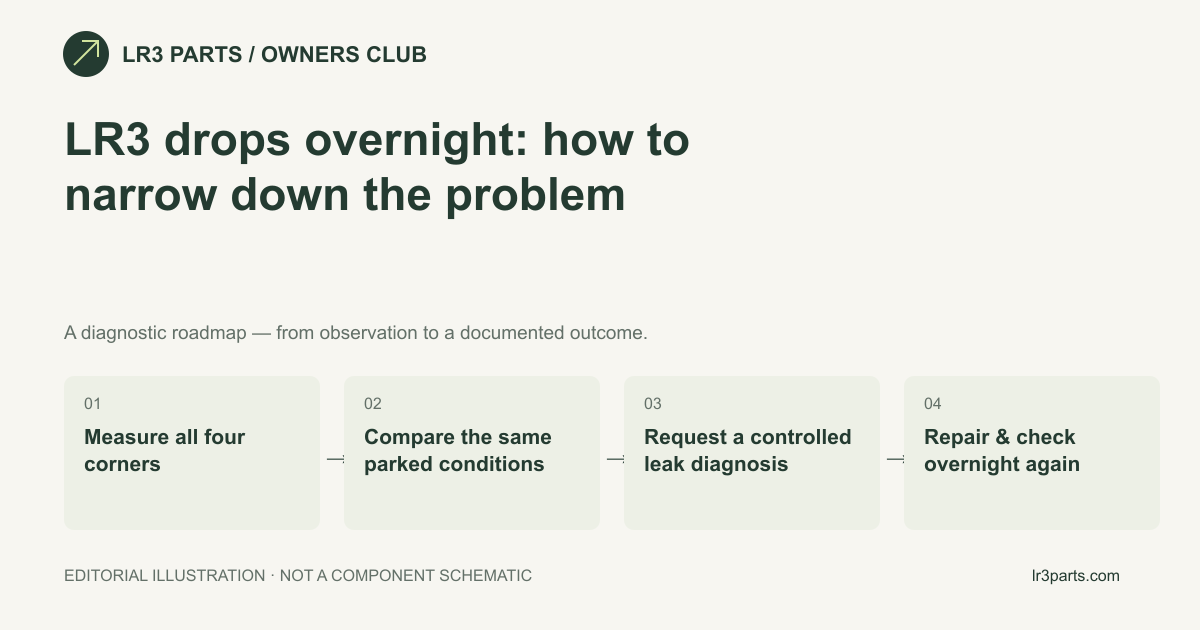
- Measure all four corners
- Compare the same parked conditions
- Request a controlled leak diagnosis
- Repair & check overnight again
Editorial roadmap, not a component schematic.
Why the morning picture can mislead
Land Rover’s suspension description says the parked system checks its level two hours after ignition-off, then every six hours, and can make small downward adjustments. That means the morning stance can reflect both a problem and the system’s response. Several low corners alone are not proof that several air springs failed. Share the pattern with a specialist without assigning the cause.
Make an overnight record
On level ground, photograph the vehicle and measure vertically from the center of each wheel to a consistent point on its wheel arch. Label front-left, front-right, rear-left, and rear-right. Record the height setting, time, load, and ground conditions. Repeat the measurements the next morning before opening doors or starting the vehicle, while standing clear. Keep the same measuring points each time. This is an observation log, not a factory pass/fail test.
Compare like with like
Keep passenger and luggage loads consistent and avoid comparing measurements from different slopes. Note whether the pattern is repeatable and whether the truck regains its previous stance on the next normal start. A short written timeline helps the workshop distinguish a persistent parked problem from an isolated observation. Do not repeatedly cycle the height controls as a substitute for a diagnosis.
Ask for the leak to be located
Give the specialist the corner measurements and scan results. Ask how they will distinguish leakage at an air spring, pipe or connection from leakage through a valve assembly, and whether the control system is affecting the observed height. Component isolation and pressure testing need the correct workshop method. Do not remove fuses, disconnect air lines, or crawl underneath to copy an unverified internet test.
Repair the confirmed cause
Ask for the exact failed component and the evidence before authorizing parts. Have damaged pipes or fittings repaired using the specified method, and a confirmed failed spring or valve repaired or replaced according to the applicable procedure. Request the complete parts list and compatibility check. Calibration or a compressor replacement should have its own justification rather than being sold as an automatic cure for overnight sag.
Check the outcome over the same interval
After the workshop confirms normal operation, repeat your original parked observations under similar conditions. Keep the before-and-after measurements, repair details, and how long you monitored the result. If the problem persists, those records help continue the diagnosis. Air suspension can move automatically: never rely on its height to support a vehicle, and leave pressurized-system work to qualified personnel.
Common questions
Do several low corners mean several failed air springs?
Not necessarily. Land Rover describes periodic downward re-levelling while parked. The morning height pattern can reflect both a problem and the system’s response; it does not prove which component is leaking.
How can I document overnight suspension sag?
On level ground, record all four wheel-center-to-arch measurements and the load, height setting, and time. Repeat at the same points before opening doors or starting the vehicle. This observation log is not a factory pass/fail test.
Keep reading
What happened on your truck?
Help turn a question into a documented outcome. Suggest a correction if something in this guide needs updating.
Submit your fix