LR3 suspension fault: checks before buying a compressor
Capture the evidence, understand repair options, and avoid replacing a compressor on the strength of a dashboard message.
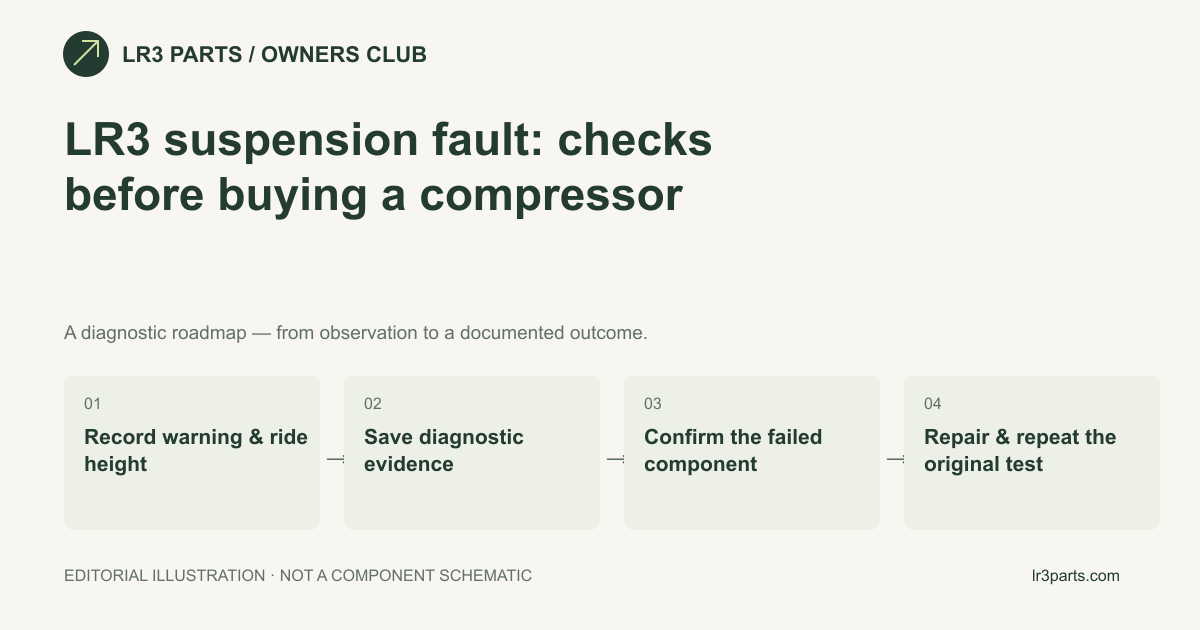
- Record warning & ride height
- Save diagnostic evidence
- Confirm the failed component
- Repair & repeat the original test
Editorial roadmap, not a component schematic.
Start with the warning, not a part number
Photograph the complete dashboard message and any other warnings. Note whether it appeared at startup, while driving, or during a height change. Record whether the truck remained level, lowered, or struggled to rise. Those observations give a workshop a repeatable starting point; the words “suspension fault” alone do not identify a replacement part.
Keep your first checks outside the truck
Observe the vehicle from a safe position on level ground. Record visible height differences, recent suspension work, battery work, modifications, and when the fault first appeared. Do not keep commanding height changes to see whether the message disappears. If the vehicle has dropped severely or the handbook directs you to stop, arrange assistance rather than continuing your trip.
Save a scan before clearing anything
Use a vehicle-compatible diagnostic tool according to its official instructions, or ask a specialist for a full scan report. Keep the exact codes, module names, and associated test results. Ask the workshop which observation or measurement supports its diagnosis. Clearing a warning is not evidence that its cause has been repaired. GAP’s official documentation is linked below for owners who use an IIDTool.
Choose the repair only after testing
Ask the specialist to distinguish an air leak from an air-supply problem and a control or electrical fault. Request a written explanation of the failed test and the proposed repair. A confirmed leaking component needs its own repair; a compressor purchase does not substitute for finding the leak. Avoid treating a forum code list as a universal instruction to replace a particular part.
If a compressor replacement is confirmed
Identify the compressor already fitted and the exact replacement kit. Arnott explains that changing from an original Hitachi compressor to its AMK replacement requires a software update. Its installation manual also specifies qualified installation and safe handling of the pressurized system. Confirm the kit instructions, programming, relay requirements, fittings, and included hardware with your installer before ordering. These requirements depend on the replacement being used.
Verify the repair and share the ending
Ask the workshop to repeat the conditions that triggered the fault and document the result. Save the diagnosis, installed part number, software work, invoice, and any follow-up observations in My Garage. If the warning returns, add the new scan rather than starting the story over. A useful owner contribution includes what was tested, what failed, and what happened after the repair.
Common questions
Does an LR3 suspension warning mean I need a compressor?
No. The warning alone does not identify the failed component. Ask for the exact diagnostic codes and the test that supports a leak, air-supply, control, or electrical diagnosis.
Does changing an LR3 compressor require programming?
It depends on the replacement. Arnott specifies a software update when changing from an original Hitachi compressor to its AMK replacement. Confirm the instructions for the exact kit with your installer.
Keep reading
What happened on your truck?
Help turn a question into a documented outcome. Suggest a correction if something in this guide needs updating.
Submit your fix